Children's speech
She knows exactly what she wants to say.
For roughly 1 in 12 young children, certain speech sounds are hard to produce clearly — and the world keeps asking them to say it again. The problem was never the thinking. It's the gap between what she means and what others hear.
— what a child hears, all day
Feel it
Try to be understood
You're four years old. You want the red ball. Tap to say it — and watch what comes back.
You know the words perfectly in your head. Your mouth makes them a little differently. Tap “Say it” and see how the grown-up responds.
You say:
“I want the red ball.”
The grown-up:
…
A gentle simulation of one small, constant frustration. Press Begin when you're ready.
What it is
A clarity problem, not a thinking problem.
Speech-sound difficulties are when a child has trouble producing certain sounds clearly enough to be understood — substituting, dropping, or distorting them (“wabbit” for “rabbit”). Some errors are a normal part of development at a given age; they're flagged when they persist or make a child hard to understand. Most have no known cause, and many children make excellent progress with patient, repeated practice.
The catch: progress depends on high-frequency, well-cued repetition — far more than a weekly 30-minute session can deliver. So the practice that actually drives improvement has to happen at home, where parents are flying blind.
What people feel
A child's confidence, and a parent's worry.
For the child: being asked to repeat themselves, being talked over, slowly shrinking back in class. For the parent: a quiet, persistent worry tangled up in logistics — getting an evaluation, fighting a waitlist, affording sessions, trying to help at home without knowing if it's working or if their child is even improving.
The hardest part is the not-knowing. Progress is invisible between appointments, and the most important early window keeps ticking.
The app
SpeechSeed
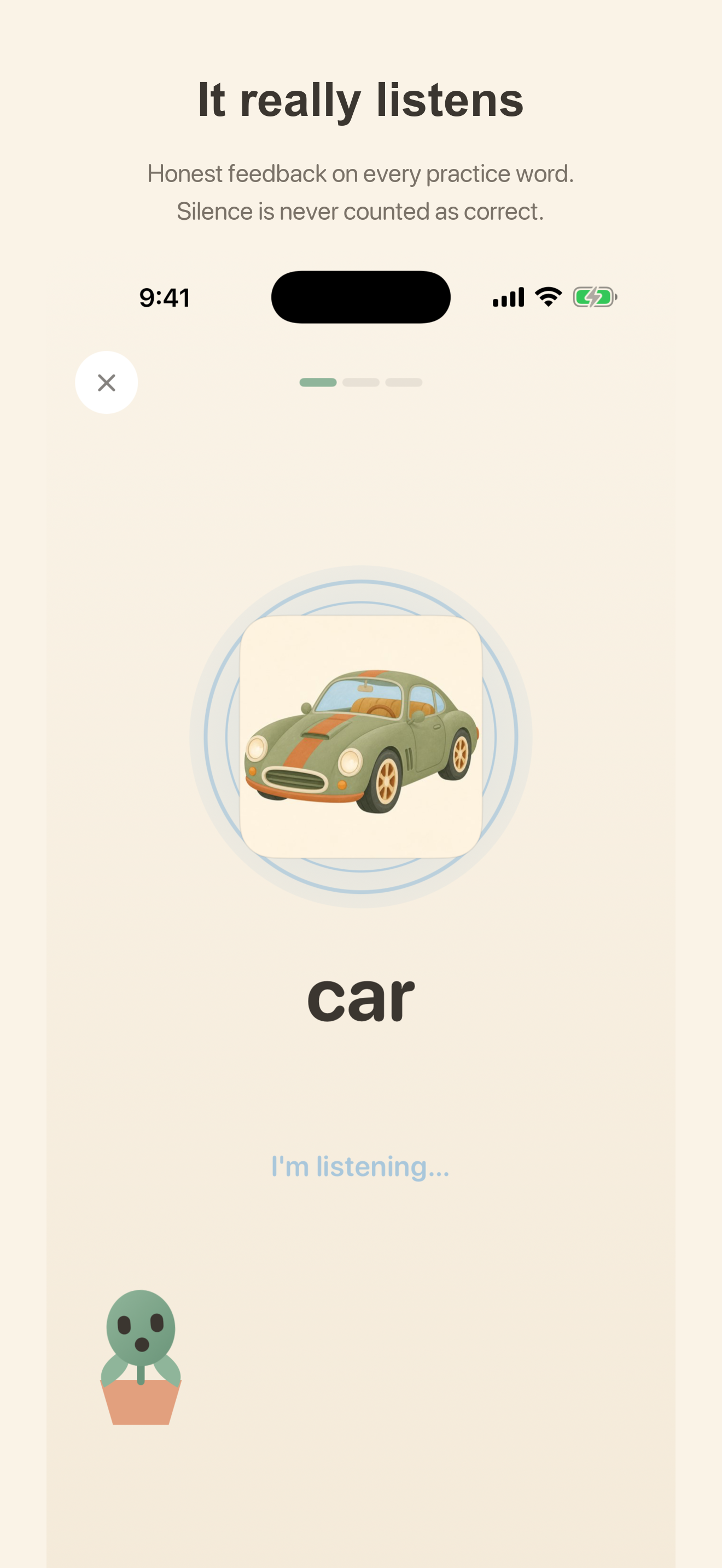
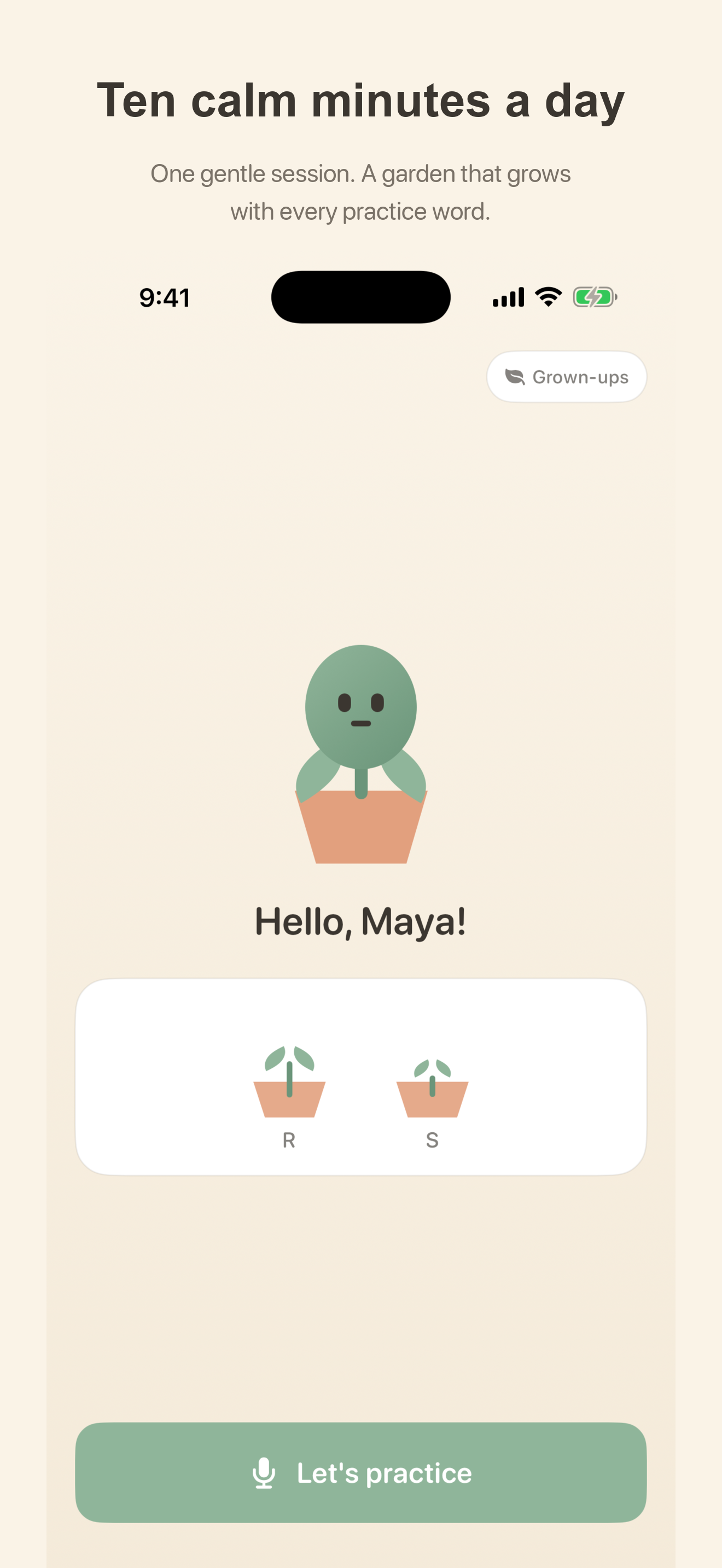
A patient articulation coach that actually listens — and never says “what?”
SpeechSeed listens on-device (the audio never leaves the phone) and gives honest feedback — not inflated praise, an accurate read of where your child is. It's built for the time between sessions, or for families who can't reach therapy at all: repeatable, motivating, and finally visible progress, without a waitlist.
SpeechSeed is daily practice and honest tracking. It is not a diagnosis, not therapy, and not a replacement for a speech-language pathologist.